Lesson
From Daniel to Christ
Daniel wrote in the sixth century BC. His visions trace four empires, a cruel king, and a countdown that lands on the week Jesus rode into Jerusalem. Part 1 of The God Who Keeps Time.
October 11, 2026
Part 1 of 2 in The God Who Keeps Time. Part 2 is Watching Wisely.
Watch the sermon (River Center , March 30, 2025).
Daniel is a truly incredible book. Most people know it for the seventieth week, which is future prophecy. But there is a lot of fulfilled prophecy in Daniel that shows the fingerprints of God. You can see those fingerprints all through the Bible. In Daniel they are really incredible.
There was not time on a Sunday morning to go over everything. A lot of the history lives in the minor lessons below. I really encourage you to take the time and study it yourself.
The book and its names
If you know me, I like Genesis 5, so I love names. Daniel means ‘God is my judge.’ Nebuchadnezzar means ‘Nabu, protect my heir.’ Nabu was the Babylonian god of writing, wisdom, and prophecy. Isn't it ironic that a man named after a god of prophecy needed a servant of the true God to explain the prophecies he was given?
Daniel lived through the whole thing. He was carried to Babylon as a young man. Skeptics argue the book was written around 167 to 164 BC. The book itself says it was Daniel, in the sixth century BC.
Four empires
I break Daniel's prophecy into four parts: Nebuchadnezzar's dream of the statue in Daniel 2, the four beasts in Daniel 7, the ram and the goat in Daniel 8, and the kings of the North and the South in Daniel 11. All four cover the rise and fall of the same four empires: Babylon, then the Medo-Persian Empire, then the Greek Empire, and last the Roman Empire. You'll notice I don't really have an end date on Rome. It never really got conquered.
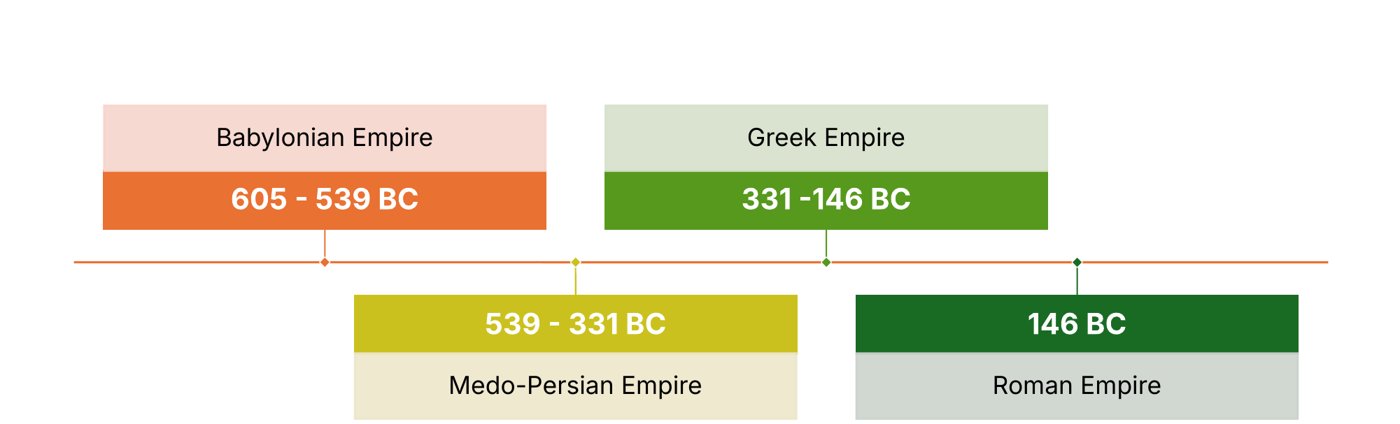
When you look at all of it, and there are many more parallels than I can fit here, it becomes hard to argue that a sixth century writer could do this on his own.
How skeptics answer
The main answer is a late date. The skeptic says Daniel was written around 167 to 164 BC, after the events. Every argument for that date comes back to one starting point: prophecy is impossible. I would call that a blind position. Dig into the arguments even a little and they fall apart.
Counting to the King
Daniel 9 gives a countdown. From the decree to restore and rebuild Jerusalem until the Messiah, the Prince, there will be "seven weeks and sixty-two weeks." Then "the Messiah will be cut off." If you'll indulge me in a little math, that countdown lands on the week Jesus rode into Jerusalem.
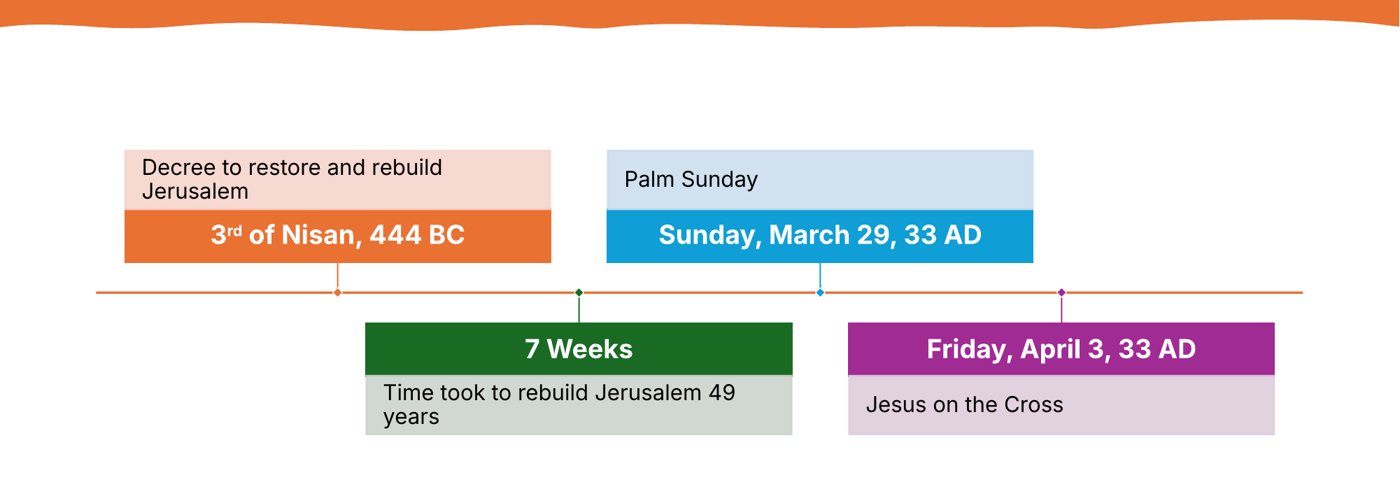
What Daniel shows us
Even if for some weird reason Daniel was a second century writer, you still have a problem. No one in the second century BC could have written down the day the Messiah would present Himself. That is a fingerprint from God, showing us who Christ was going to be and when He was going to arrive. We had the blueprint.
We do not have that kind of countdown for His second coming. But we do have the signs and the seasons. We should be looking for them, so that when they happen we are prepared. That is Part 2: Watching Wisely.
Thank You, Lord, for confirming the authorship of within Scripture itself, so that we know we can trust everything You have written down for us. Open our eyes to Your path and Your signs, so that we may see them clearly.
This lesson's home is Prophecy.