Minor lesson
The Three Major Views
Premillennial, postmillennial, and amillennial Christians read the thousand years of Revelation 20 differently, and so they place the second coming and the tribulation differently. All three agree Christ is coming again.
September 20, 2026
There are three major views. There are other views too, and tons of variations within each one, but these are the ones nearly everyone falls under. I am going to keep it general. Each view looks at what the Bible calls the in a different way. So let's go to Revelation 20 and see what the millennium is.
Then I saw an angel coming down from heaven with the key to the Abyss, holding in his hand a great chain. He seized the dragon, that ancient serpent who is the devil and Satan, and bound him for a thousand years. And he threw him into the Abyss, shut it, and sealed it over him, so that he could not deceive the nations until the thousand years were complete. After that, he must be released for a brief period of time.
And down in verse 7:
When the thousand years are complete, Satan will be released from his prison, and will go out to deceive the nations in the four corners of the earth—Gog and Magog—to assemble them for battle. Their number is like the sand of the seashore.
So this is the thousand years. Is it an actual thousand years? Is it more interpretive, just a long period of time? Everyone agrees it is a golden age, when Christ is reigning and Satan is bound. So what is it, how long is it, and when is it?
One note about Gog and Magog. They show up in more than one place. Seeing the names in two places does not necessarily mean it is the same group or the same event. Be careful with that when you read. Sometimes it is talking about different events.
What everyone agrees on
Start with the timeline everyone shares: at the beginning, the judgment at the end. Fairly simple. Everyone agrees on that. Everything in between is what we do not agree on.
The three positions are premillennialism (that is what I am), postmillennialism, and amillennialism. I will often shorten them to premill, postmill, and amill.
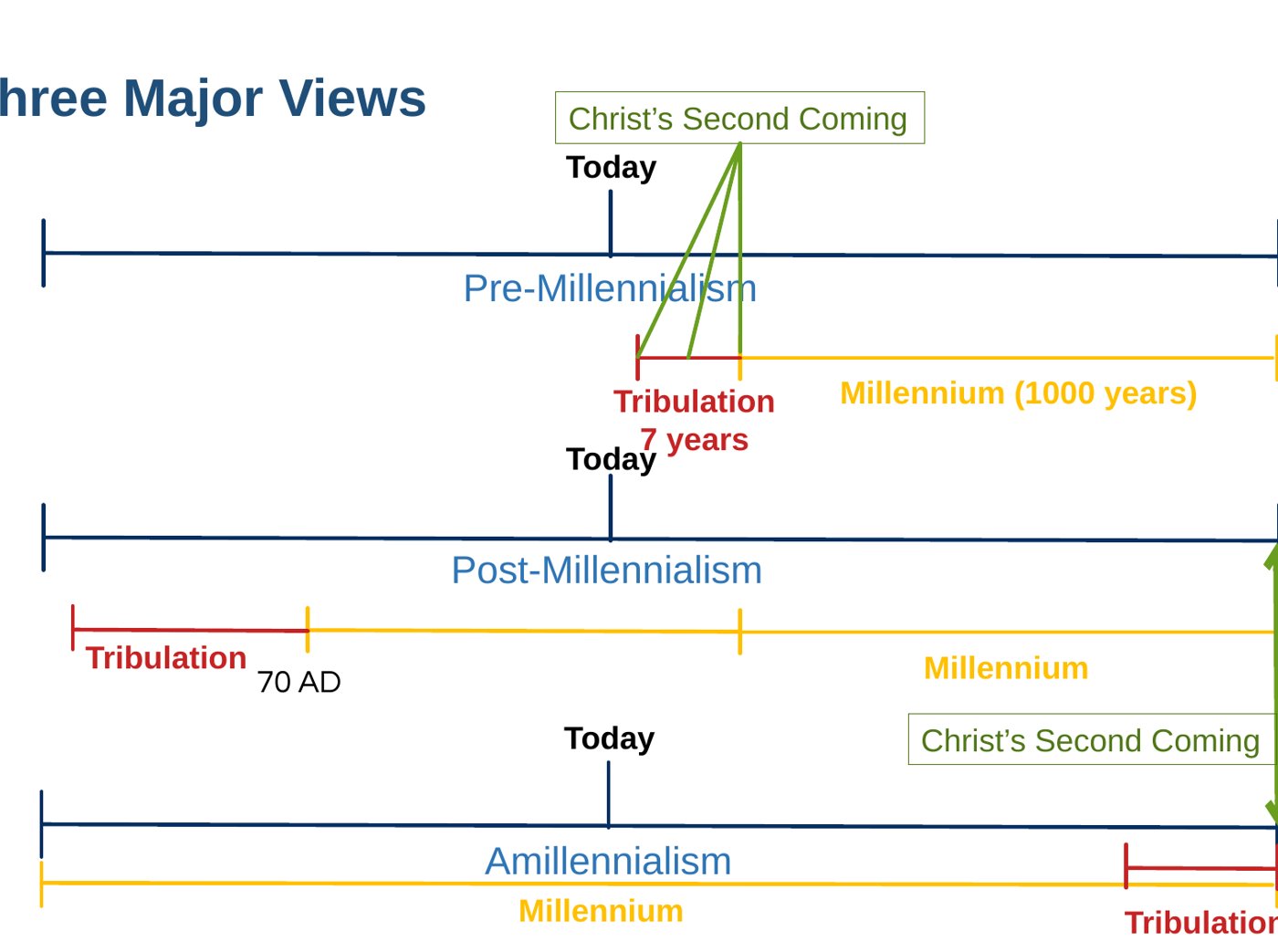
Where is the millennium?
Premillennials emphasize Christ actually reigning on the earth, on David's throne, as Zechariah 14 says.
On that day the LORD will become King over all the earth—the LORD alone, and His name alone.
The others will generally say this is more spiritual: Christ rules from heaven instead of on earth.
- : the millennium is a literal thousand years, at the end, right before the final judgment.
- : there is some flexibility. Some believe it started back in AD 70, after the destruction of Jerusalem. Others believe the spread of will turn into this golden age. Like premillennials, they believe the millennium ends at the end.
- : they do not believe in a millennium in a literal sense. They see good times and bad times through the whole age. So it is all of it and none of it at the same time.
It is sometimes hard for me to pin the amillennial view down, because I am basically on the other end of the spectrum. I end up reading the Bible very literally the vast majority of the time.
Where is the second coming?
This is actually where the names come from.
- Premillennial: Christ comes before the millennium. Premillennials put it in a few different spots depending on what they think about the , but it always comes before the millennium.
- Postmillennial: Christ comes after the millennium, at the very end, right before the judgment.
- Amillennial: Christ comes at the end, but there really is no millennium.
Reading Revelation 19 and 20 in order
Premillennials read Revelation 19 and 20 in a very literal order, one line after the other. Here are pieces of both chapters.
Then I saw the beast and the kings of the earth with their armies assembled to wage war against the One seated on the horse, and against His army. But the beast was captured along with the false prophet, who on its behalf had performed signs deceiving those who had the mark of the beast and worshiped its image. Both the beast and the false prophet were thrown alive into the fiery lake of burning sulfur.
Then Satan is bound for a thousand years , and when the thousand years are complete, he is released . Then:
Then I saw a great white throne and the One seated on it. Earth and heaven fled from His presence, and no place was found for them. And I saw the dead, great and small, standing before the throne. And books were opened, and one of them was the Book of Life. And the dead were judged according to their deeds, as recorded in the books.
Premillennials take that as the order: battle, millennium, battle, judgment. The others read it more like Genesis, which goes over the creation story and then goes over it again in a different way. They do not read it as a literal telling of the future timeline. That difference changes how you view everything else.
Where is ?
- Premillennial: a seven-year tribulation, the seventieth week of Daniel, with the rapture somewhere in there depending on your view, and then the second coming.
- Postmillennial: again, some flexibility. Some believe the tribulation was back in AD 70 when Jerusalem was destroyed. Some believe there will be a kind of last battle near the end. Some think both.
- Amillennial: there is likely to be a buildup near the end, but it is never a specific seven-year time frame or a specific set of events. It is a turbulent time. Troubled times and golden times both happen through the whole age.
For more on the rapture views, see The Tribulation.
What each view is watching for
Postmillennials are generally the most hopeful. What would you not want about looking toward a golden age coming soon, with nothing bad in between? But they are also not really looking for anything, because they are focused on spreading the word, and a golden age will come at some point where Christ rules.
Amillennials are not really looking for anything either. Along with postmillennials, and even many premillennials, they take Jesus' words in Matthew at face value: "No one knows about that day or hour, not even the angels in heaven, nor the Son, but only the Father."
I hope I have done enough justice to these views to help you understand where they are coming from. They fully believe in Christ's second coming. They fully believe in the crucifixion, the judgment, everything. They just do not agree with us on the middle parts.
Next: The Seventieth Week.
This is a deeper teaching under Watching Wisely. Its home is Prophecy.