Minor lesson
Antiochus IV Epiphanes
The insolent king, skilled in intrigue. He took a throne that was not his, sold the high priesthood, was turned back by Rome, defiled the temple, and died far from Jerusalem, not by human hands.
October 11, 2026
An insolent king
"In the latter part of their reign, when the rebellion has reached its full measure, an insolent king, skilled in intrigue, will come to the throne." Daniel 11 adds, "In his place a despicable person will arise; royal honors will not be given to him, but he will come in a time of peace and seize the kingdom by intrigue."
The man we are talking about is Antiochus IV, called Epiphanes. He is what you might call a modern slimy politician. He was great at backroom deals and deceit, any contemptible thing you can think of. Surprisingly, he liked to mingle with commoners, which the elite of his time did not like. My guess is he was a charismatic person, but very, very slimy.
Polybius, who lived at the time, describes him slipping out of the palace to wander the city, drinking with common people and visiting the workshops of craftsmen. Epiphanes means ‘God made manifest.’ Polybius says some people called him Epimanes instead, ‘the madman.’
Royal honors not given to him
He was not of the royal line of succession. He started as a hostage in Rome. His brother, Seleucus IV, was the one in charge. Through some sort of deal, Antiochus was able to swap places with Seleucus's son, who was the next heir. Then, by a mysterious set of circumstances, Seleucus IV died, killed by one of his own officials. Antiochus said, in effect, ‘I have a nephew, his other son, who is a small child. We will make him king, and I will be co-regent.’ That is how he came to rule. He was not given the honor of royalty. He took it. Some years later that child, mysteriously, died, and Antiochus IV ruled over all.
Appian says the Seleucid heir Demetrius was sent to Rome in exchange for Antiochus, and that Heliodorus killed Seleucus IV in 175 BC. Antiochus came back with help from King Eumenes of Pergamum and took power. A Babylonian king list and inscriptions show a young son of Seleucus IV, also named Antiochus, reigning jointly with him until about 170 BC, when the boy was killed.
A prince of the
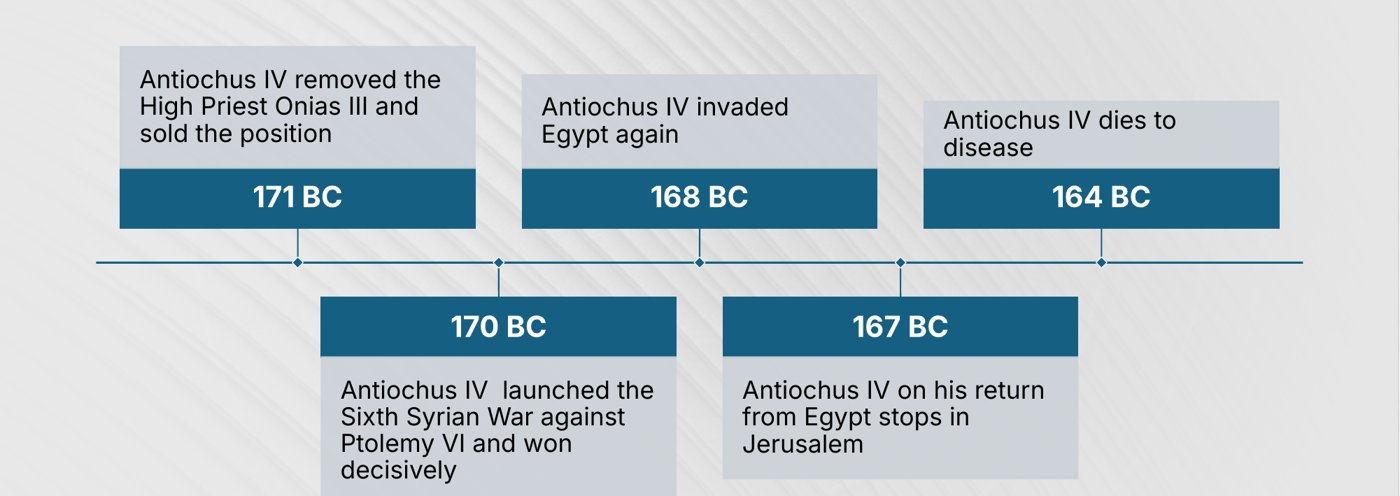
He had no problem making the Jews angry. "Then a flood of forces will be swept away before him and destroyed, along with a prince of the covenant." In 171 BC he removed the high priest, Onias III, and sold the office to the highest bidder. He had no problem putting people in place who would give him money.
Second Maccabees tells it in two steps. In 175 BC Jason, Onias' brother, bought the priesthood from Antiochus. About 172 BC Menelaus outbid Jason by 300 talents. Onias III was murdered about 171 BC. Many read "a prince of the covenant" as Onias III.
The first invasion of Egypt
"In a time of peace, he will invade the richest provinces and do what his fathers and forefathers never did. He will lavish plunder, loot, and wealth on his followers, and he will plot against the strongholds, but only for a time."
This is his attack on Egypt. He went down, captured Pelusium, and looted Egypt. But he had to be careful, because at the time the Ptolemaic kingdom was in alliance with Rome. So through deceit and deals he kept a low profile and got out of there with a lot of money.
This is the Sixth Syrian War, 170 to 169 BC. Antiochus defeated the army of his nephew Ptolemy VI near Pelusium and took Ptolemy into his hands. The two kings then negotiated. Compare Daniel: "the two kings, with their hearts bent on evil, will speak lies at the same table, but to no avail." On his way home with great wealth, he plundered the temple in Jerusalem, taking the golden altar, the lampstand, and the vessels. "The king of the North will return to his land with great wealth, but his heart will be set against the holy covenant."
The ships of Kittim
He started a second campaign in 168 BC. "At the appointed time he will invade the South again, but this time will not be like the first. Ships of Kittim will come against him, and he will lose heart. Then he will turn back and rage against the holy covenant and do damage."
This is exactly what happened. Kittim is a general term for the people of the Mediterranean, and here it is Rome. Rome sent a messenger to him, and the messenger drew a circle in the sand around him. He told Antiochus that he could not leave that circle until he gave an answer to take back to Rome. The heavy implication was that if he did not turn back right now, Rome was getting involved. Rome was not someone he wanted to mess with. So, very begrudgingly, he turned back and went home.
The Roman envoy was Gaius Popillius Laenas, at Eleusis near Alexandria, in 168 BC. Rome had just defeated Macedon at Pydna. Kittim first meant Cyprus and then, more broadly, the islands and coasts to the west. The old Greek translation of Daniel already translates "ships of Kittim" in Daniel 11:30 as ‘Romans.’
The abomination of desolation
On his way home, he stopped by Jerusalem. "His forces will rise up and desecrate the temple fortress. They will abolish the daily sacrifice and set up the abomination of desolation. With flattery he will corrupt those who violate the covenant, but the people who know their God will firmly resist him."
He loved the people who were violating the covenant. In 167 BC he slaughtered a pig on the altar. Not good. He set up Zeus in the temple, and beyond that he started forcing the Jewish people to eat pork on penalty of death. For whatever reason, he really hated the Jewish people. It is an amazing story, written down in Daniel ahead of time, and it shows exactly who this man was.
First Maccabees dates the ‘desolating sacrilege’ on the altar to Chislev of 167 BC, and describes the ban on circumcision, the burning of Torah scrolls, and the forced sacrifices. Second Maccabees says the temple was renamed for Olympian Zeus, and tells of the old scribe Eleazar and the seven brothers who died rather than eat pork. says swine were sacrificed on the altar. The sources describe an altar or image of Zeus in the temple; they do not clearly say it stood in the Holy of Holies.
"The people who know their God" resisted. The priest Mattathias and his sons, led by Judas Maccabeus, revolted. In December 164 BC they cleansed the temple and rededicated the altar. The Jews still remember it as Hanukkah. John calls it the Feast of Dedication, and Jesus Himself was in the temple for it: "At that time the Feast of Dedication took place in Jerusalem. It was winter."
Daniel 8 gives a time span for the trampling of the sanctuary: "It will take 2,300 evenings and mornings; then the sanctuary will be properly restored." Readers count this in two ways, as 2,300 days, or as 1,150 days of evening and morning sacrifices. Either way it points to this period of the desecration and the rededication.
Broken, but not by human hands
"He will even stand against the Prince of princes. Yet he will be broken off, but not by human hands."
This is what happened to Antiochus. He died from what was likely a disease, nowhere near Jerusalem, with essentially no fanfare. His death was the start of the end of the Seleucid Empire. It started to crumble, and Rome started to really take over.
He died in 164 BC in Persia, after a failed attempt to rob a temple at Elymais. Polybius says he went mad. The Jewish books say he was struck with a sickness.
Sources sighted
- Polybius, Histories 26.1
- Appian, Syrian Wars 45
- Diodorus Siculus 30.7.2; Babylonian king list (BM 35603)
- 2 Maccabees 4:7-10, 4:23-34
- Polybius, Histories 28.18-21; Diodorus Siculus 30.14-18; 1 Maccabees 1:16-19
- 1 Maccabees 1:20-24
- Polybius, Histories 29.27; Livy 45.12; Diodorus Siculus 31.2
- Old Greek (Septuagint) Daniel 11:30
- 1 Maccabees 1:41-64
- 2 Maccabees 6:1-7:42
- Josephus, Antiquities 12.253
- 1 Maccabees 2:1-4:59
- Polybius, Histories 31.9; 1 Maccabees 6:1-16; 2 Maccabees 9
This is a deeper teaching under From Daniel to Christ. Its home is Prophecy.