Minor lesson
The Sixty-Nine Weeks
From the decree to rebuild Jerusalem to the Messiah, the Prince, seven weeks and sixty-two weeks. Which decree, how long a year is, and the math that lands on Palm Sunday.
October 11, 2026
If you will indulge me in a little math lesson, I promise I am not going to make you do the math. But there is something really incredible here. This is about the seventy weeks of Daniel. Not the seventieth week, which is still ahead (see The Seventieth Week in Part 2), but the earlier parts.
The timeline
"Know and understand this: From the issuance of the decree to restore and rebuild Jerusalem until the Messiah, the Prince, there will be seven weeks and sixty-two weeks. It will be rebuilt with streets and a trench, but in times of distress. Then after the sixty-two weeks the Messiah will be cut off and will have nothing."
So we have a timeline. A decree happens. Seven weeks happen. Then sixty-two weeks, and the Messiah, the Prince. Sometime after the sixty-two weeks, the Messiah will be cut off.
These are not weeks like days. In this context they are weeks of years. Daniel is talking about seventy groups of seven. "Seventy weeks are decreed for your people and your holy city." So seven weeks is seven groups of seven, forty-nine years. Seven weeks and sixty-two weeks is sixty-nine weeks, 483 years.
Daniel was already thinking in years when the vision came. He had been reading Jeremiah "that the desolation of Jerusalem would last seventy years." Seventy sevens of years answers seventy years.
Which decree?
There are three possible decrees.
- Cyrus, "in the first year of Cyrus king of Persia." But that decree is about rebuilding the temple: "has appointed me to build a house for Him at Jerusalem." Daniel's decree is about rebuilding Jerusalem.
- Artaxerxes, 457 BC, in Ezra 7. Again, this one is about the temple, "to so honor the house of the LORD in Jerusalem."
- Artaxerxes, in the month of Nisan, in his twentieth year. "Now in the month of Nisan, in the twentieth year of King Artaxerxes." Nehemiah asked, "If it pleases the king, and if your servant has found favor in your sight, I ask that you send me to Judah, to the city where my fathers are buried, so that I may rebuild it." And "because the gracious hand of my God was upon me, the king granted my requests."
The twentieth year of Artaxerxes is 445 or 444 BC. Because it is in Nisan, here it is 444 BC. That really describes the decree we are talking about: a decree to rebuild the city.
Cyrus' decree is usually dated about 538 BC (the sermon slides say 534 BC). The 444 BC date follows Harold Hoehner, who argued that Nehemiah counted Artaxerxes' years from the fall (Tishri), so Nisan of his twentieth year falls in the spring of 444 BC. Others use 445 BC.
Funny thing: tells us it took them forty-nine years, seven weeks, to rebuild Jerusalem. It is kind of interesting that a source outside the Bible tells us why there are seven weeks there. does not say.
Josephus says Nehemiah finished the wall in two years and four months. Nehemiah 6:15 gives fifty-two days for the wall itself. The forty-nine years is often explained as the time to finish rebuilding the city as a whole.
How many days are in a year?
This is the funny question. In Scripture, a prophetic year is 360 days.
"In the six hundredth year of Noah's life, on the seventeenth day of the second month, all the fountains of the great deep burst forth." "After 150 days the waters had gone down. On the seventeenth day of the seventh month, the ark came to rest on the mountains of Ararat." Five months, 150 days. That is thirty days per month.
We see the same thing in Revelation 11. The nations "will trample the holy city for 42 months," and the two witnesses "will prophesy for 1,260 days." Forty-two months of thirty days is 1,260 days.
This is not me messing around with the math to get what I want. It is a common thing. Other ancient peoples, such as Babylon and India, had 360-day calendars. They obviously knew the year was longer. Like the Jewish people, they would add a month now and then to keep the calendar from getting too far off.
Here comes the math
- 69 weeks × 7 years × 360 days = 173,880 days.
- The first of Nisan in 444 BC was March 5, 444 BC.
- 173,880 days is 476 of our 365-day years, plus leap days. This is the Julian calendar, so there are no century exceptions; you just divide by four.
- That leaves 22 remaining days. Remember there is no year zero.
- You end up with Friday, March 27, AD 33.
Something interesting: AD 33 and AD 30 are the two years most people believe Christ died on . AD 33 is probably the more prominent.
Now remember, the countdown is "until the Messiah, the Prince," and the Messiah is cut off after it. If you push the decree to the third of Nisan, the count lands on Sunday, March 29, AD 33. That is Palm Sunday, because Jesus died on the cross that Friday, when the lambs were slain, Friday, April 3, AD 33.
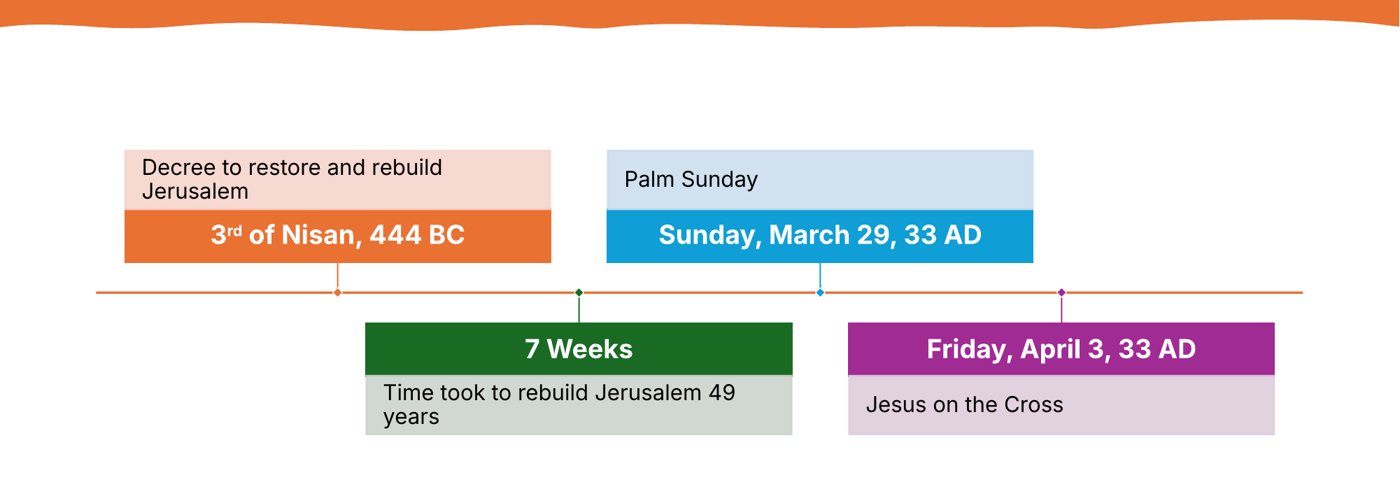
The new moon that began Nisan in 444 BC and the Passover of AD 33 come from astronomical tables. AD 33 dates the crucifixion to Friday, April 3, and AD 30 to Friday, April 7.
Cut off, and will have nothing
Daniel says the Messiah will be "cut off," which means killed, "and will have nothing." (Some translations read ‘but not for Himself.’) Then "the people of the prince who is to come will destroy the city and the sanctuary." Jerusalem and the temple were destroyed by Rome in AD 70, after the Messiah was cut off, just as the order of the verse says.
Next: The Time of Your Visitation.
Sources sighted
- Ezra 1:1-4; standard Bible dictionaries
- Harold W. Hoehner, Chronological Aspects of the Life of Christ (1977), ch. 6
- Josephus, Antiquities 11.179
- Richard A. Parker and Waldo H. Dubberstein, Babylonian Chronology 626 B.C.-A.D. 75 (1956)
This is a deeper teaching under From Daniel to Christ. Its home is Prophecy.